
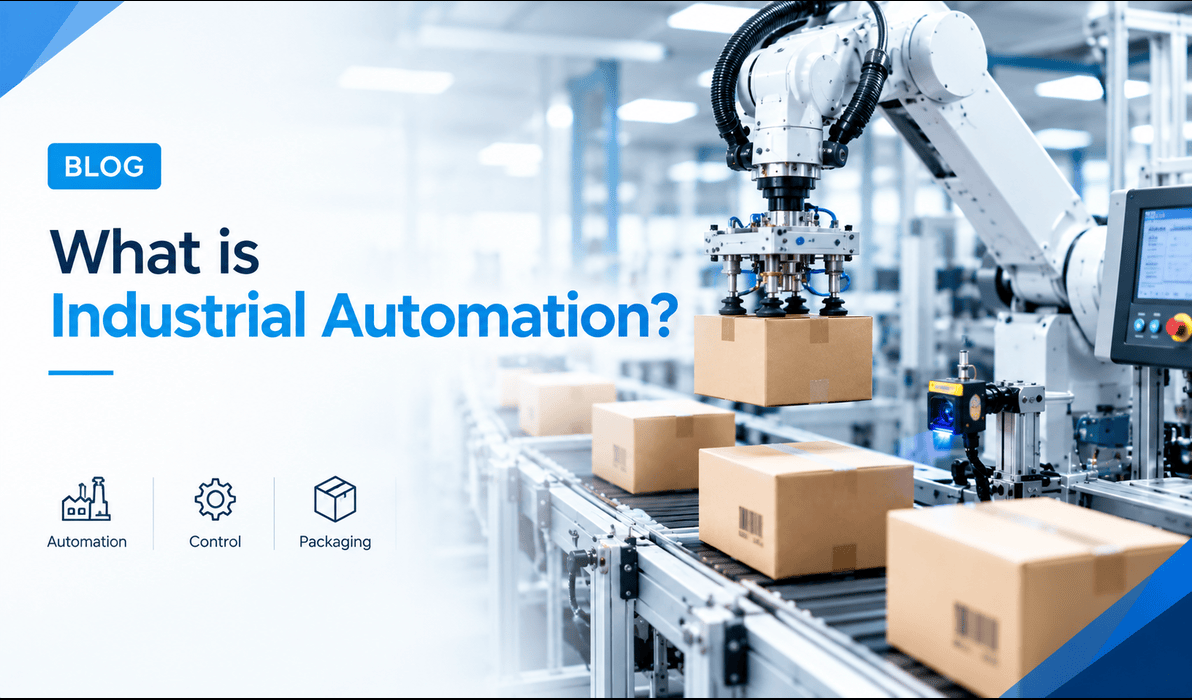
Industrial automation is the use of machines, control systems, sensors, software and other technologies to perform manufacturing and production tasks with less manual intervention. It helps businesses improve production consistency, monitor processes and manage repetitive operations more efficiently.
From packaging and product identification to machine control and material handling, automation can be applied across different stages of an industrial production line.
How Does Industrial Automation Work?
An automated production system generally combines different components that communicate with each other. Industrial sensors can detect objects, position, movement or process conditions, while controllers process the information and trigger the required machine operation.
Depending on the application, automation systems may include:
- Industrial sensors
- Pneumatic components
- Control systems
- Motors and drives
- Coding and marking equipment
- Packaging machinery
- Inspection systems
- Product traceability solutions
These components can work together to create a more consistent and organized production process.
Types of Industrial Automation
Industrial automation can be implemented in different ways depending on production volume and process requirements.
Fixed Automation
Fixed automation is designed for repetitive, high-volume production where the same operation is performed continuously.
Programmable Automation
Programmable systems allow production parameters and machine operations to be changed for different batches or products.
Flexible Automation
Flexible automation allows manufacturers to handle product variations with less manual adjustment, making it suitable for changing production requirements.
Integrated Automation
Integrated automation connects multiple machines, control systems and production processes into a coordinated manufacturing environment.
Role of Coding and Marking in Industrial Automation
Product identification is an important part of automated manufacturing. Production lines may need to print batch numbers, manufacturing dates, expiry dates, barcodes and product information automatically.
Technologies such as Continuous Inkjet Printers, Thermal Inkjet Printers, DOD Printers and Laser Marking Machines can be selected according to the product, substrate and production requirements.
TechAttar provides industrial coding, marking and packaging technologies for manufacturers across the GCC, along with sensors, pneumatic components and product traceability solutions.
Benefits of Industrial Automation
Industrial automation can help manufacturers:
- Improve production consistency
- Reduce repetitive manual operations
- Maintain product quality
- Improve production-line efficiency
- Support product traceability
- Reduce process errors
- Monitor machine operations
- Improve packaging productivity
The actual benefits depend on the application, equipment configuration and production environment.
Industrial Automation for Modern Manufacturing
Automation is not limited to robots or fully automated factories. A manufacturer can automate individual processes such as product coding, carton sealing, packaging, inspection or object detection without completely replacing the existing production line.
For businesses looking for Industrial Automation Solutions UAE, the right approach is to identify the production problem first and then select suitable equipment and technology.
TechAttar supports industrial applications with coding and marking systems, packaging automation, sensors, pneumatic solutions and product traceability technologies across the GCC.
0 Comments
No comments yet. Be the first to share your thoughts!